Byzantine Minuscule is a script for writing the Greek language, used in the Eastern Roman Empire from the 9th century until the fall of Constantinople in the 15th century. It was developed from earlier all-uppercase Uncial scripts, and is the precursor to many modern Greek typefaces.
Written out, characters many "flow" into one another continuously based on certain rules, similar to modern handwritten cursives. There are also a variety of ligatures where certain letters may change shape quite a bit when surrounded by certain other letters. These ligatures evolved over time, and some were more commonly used than others. Later scripts evolved into a highly ornamental style.
There are extensive digital scans of Byzantine Minuscule manuscripts available online, especially at the Digitized Vatican Library. Vat.gr. 1156 is a beautiful manuscript starting with the Gospel of John from the 11th century, which in the first few pages features both minuscule and majuscule forms used alongside eachther interchangeably, displays interesting alternative forms for ζ and ξ, and demonstrates a variety of simple ligature rules.
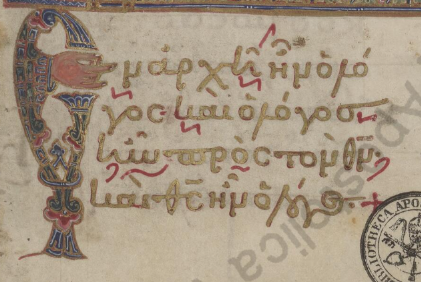
The first text from Vat.gr 1156.
ἐν ἀρχῇ ἦν ὁ λόγος, καὶ ὁ λόγος ἦν πρὸς τὸν θεόν, καὶ θεὸς ἦν ὁ λόγος
The Boldeian Library at Oxford also has an extensive collection of digitized manuscripts. MS. D'Orville 301 is an old manuscript from the 9th century which includes the Elements by Euclid. Many word endings are written above the rest of the word, as we see here with 'σημεῖ' followed by a floating 'ον'.
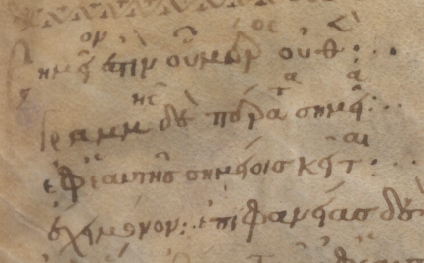
The first text the D'Orville Elements.
σημεῖόν ἐστιν οὗ μέρος οὐθέν
And again Euclid's Elements, this time from Vat.gr.190, also from the 9th century. In both the above and below examples see how the letters of ἐστιν connect together.

The first text the Vatican vat.gr.190 Elements.
σημεῖόν ἐστιν οὗ μέρος οὐθέν
The Byzantine Minuscule Transliterator on this site uses characters based off of the standardized set presented on the Vatican website. This follows an earlier "old round" style before the script became more cursive and ornamentalized. The Transliterator also avoids use of diacritical abbreviations of characters.